What Is Social Marketing? Driving Local Change
- Eddie The Chef
- a few seconds ago
- 7 min read

Managing a retail business in Gippsland often means juggling community expectations with commercial goals. Understanding how social marketing drives positive behavioural change gives local retailers a powerful edge in building stronger community ties and setting themselves apart. This guide reveals how Australian-focused social marketing strategies can help you connect authentically with residents while contributing to the wellbeing of Gippsland.
Table of Contents
Key Takeaways
Point | Details |
Social Marketing Focuses on Collective Wellbeing | It prioritises social good and aims for behaviour change rather than commercial success. |
Strategic Framework Drives Effectiveness | A multidisciplinary approach combines research, audience understanding, and tailored interventions for impactful outcomes. |
Local Relevance is Key for Retailers | Gippsland retailers can enhance community engagement and brand reputation by aligning marketing efforts with local social issues. |
Ethical Implementation is Essential | Responsible strategies that respect community dynamics foster trust and ensure sustainability in social outcomes. |
Defining Social Marketing In Today’s Australia
Social marketing represents a sophisticated approach to driving meaningful change by strategically applying marketing principles towards solving critical social challenges. Unlike traditional commercial marketing, this discipline focuses on influencing behaviour for collective wellbeing rather than individual product sales.
At its core, social marketing integrates marketing techniques with ethical behaviour change strategies. Marketing principles are applied to solve social problems such as public health, environmental protection, poverty reduction, and community education. The Australian approach emphasises developing innovative solutions aligned with broader societal goals.
Key characteristics of social marketing include:
Prioritising social good over commercial profit
Utilising evidence-based behavioural insights
Developing segmented, targeted communication strategies
Addressing complex community challenges
Promoting sustainable, long-term social transformation
The Australian Social Marketing Framework typically involves comprehensive research, strategic planning, and ethical implementation. Practitioners carefully analyse target audiences, design interventions, and measure social impact using robust methodological approaches.
Social marketing aims to deliver competition-sensitive, segmented social change programs that are effective, efficient, equitable, and sustainable.
Pro tip: When designing social marketing initiatives, always centre your strategy around deep understanding of your target community’s specific needs and cultural context.
Core Principles And Strategic Frameworks
Social marketing is underpinned by a robust set of strategic principles that transform complex social challenges into targeted, actionable interventions. Strategic frameworks emphasize integrated research approaches designed to create meaningful behavioural change across diverse community contexts.
The core strategic framework comprises several critical components that guide effective social marketing practice:
Consumer-centred design and orientation
Evidence-based behavioural change methodologies
Ethical implementation strategies
Comprehensive market research techniques
Systematic monitoring and impact assessment
Behaviour change remains the fundamental objective of social marketing initiatives. Practitioners carefully analyse target audience segments, develop tailored messaging, and create intervention strategies that address specific social challenges while respecting community dynamics and cultural nuances.
Social marketing integrates extensive research, best practice, partnerships, and ongoing refinement to ensure efficiency and sustainability in social outcomes.
Successful implementation requires a multidisciplinary approach that combines insights from psychology, sociology, communication studies, and marketing science. By applying rigorous analytical frameworks, social marketers can design nuanced interventions that genuinely motivate positive social transformation.

Here’s a quick overview comparing social marketing framework pillars and their business relevance:
Framework Pillar | Description | Business Impact |
Research & Insights | In-depth analysis of audience, context | Enables targeted, relevant interventions |
Strategic Planning | Setting goals, choosing methods | Aligns campaign with clear social objectives |
Ethical Implementation | Responsible, culturally sensitive actions | Builds trust and positive brand perception |
Measurement & Evaluation | Tracking and assessing results | Demonstrates social impact, supports funding |
Pro tip: Always conduct comprehensive audience research and develop deeply personalised communication strategies that resonate with your target community’s specific values and motivational triggers.
Common Types And Real-World Applications
Social marketing represents a powerful approach to addressing complex societal challenges through strategic intervention. Australian campaigns target critical social issues across multiple domains, focusing on sustainable behavioural transformation and community wellbeing.
The primary types of social marketing initiatives in Australia encompass several key areas:
Public Health Interventions
Alcohol consumption reduction
Smoking cessation programs
Drug abuse prevention
Mental health awareness
Community Safety Campaigns
Road safety education
Domestic violence prevention
Personal safety awareness
Environmental Sustainability
Waste reduction strategies
Water conservation initiatives
Climate change awareness
These targeted campaigns strategically move audiences from initial awareness through to sustained behavioural maintenance. Social marketers carefully design interventions that address specific community challenges, leveraging insights from psychology, communication studies, and cultural understanding.
Social marketing applications span health, environment, education, and community wellbeing, employing a sophisticated mix of interventions shaped by extensive research and community engagement.
Successful social marketing requires nuanced approaches that respect community dynamics, cultural sensitivities, and individual motivational triggers. By combining empirical research with compassionate communication strategies, practitioners can create meaningful, lasting social change.
Pro tip: Design your social marketing campaign with deep empathy, focusing on understanding the underlying motivations and barriers that prevent positive behavioural change.
Key Differences From Social Media Marketing
While social media marketing and social marketing might appear similar at first glance, they represent fundamentally distinct approaches to communication and influence. Social marketing differs fundamentally in its strategic goals and comprehensive ethical framework.
Key distinctions between these approaches include:
Objectives
Social Media Marketing: Commercial promotion and sales
Social Marketing: Behaviour change for social good
Primary Focus
Social Media Marketing: Brand visibility and engagement
Social Marketing: Community wellbeing and systemic change
Measurement Metrics
Social Media Marketing: Likes, shares, commercial conversions
Social Marketing: Measurable societal impact and behavioural shifts
The strategic approach of social marketing is deeply rooted in research, audience segmentation, and holistic community understanding. Unlike social media marketing’s primarily transactional nature, social marketing develops nuanced, multi-channel interventions designed to create meaningful, sustainable social transformation.
Social marketing integrates social media as one tool within a broader strategic approach, prioritising ethical outcomes over commercial gains.
Practitioners of social marketing view communication channels as integrated platforms for driving positive change, carefully crafting messages that respect community dynamics and individual motivational contexts. This approach demands a more sophisticated, empathetic communication strategy that goes beyond simple promotional tactics.
Pro tip: When designing communication strategies, prioritise understanding human behaviour and systemic barriers over surface-level engagement metrics.
Benefits And Challenges For Gippsland Retailers
Social marketing presents a unique opportunity for Gippsland retailers to create meaningful community impact while simultaneously enhancing their business reputation. Local retailers can strategically leverage social marketing to differentiate themselves in a competitive regional marketplace.
Key benefits for Gippsland retailers include:
Community Connection
Enhanced local brand reputation
Stronger customer loyalty
Deeper community engagement
Business Differentiation
Alignment with local social values
Competitive positioning
Authentic brand storytelling
Long-Term Strategic Advantages
Increased customer trust
Positive social impact
Potential for community partnerships
However, implementing social marketing is not without its challenges. Retailers must navigate complex considerations such as limited budgets, the need for specialized knowledge, and measuring tangible outcomes. Successful approaches require careful planning, genuine commitment, and a nuanced understanding of local community dynamics.
Social marketing allows Gippsland retailers to contribute to societal wellbeing while creating meaningful connections beyond traditional commercial relationships.
Navigating these challenges demands a strategic, patient approach. Retailers must invest time in understanding their community’s specific needs, develop targeted interventions, and remain committed to long-term social impact rather than seeking immediate commercial returns.
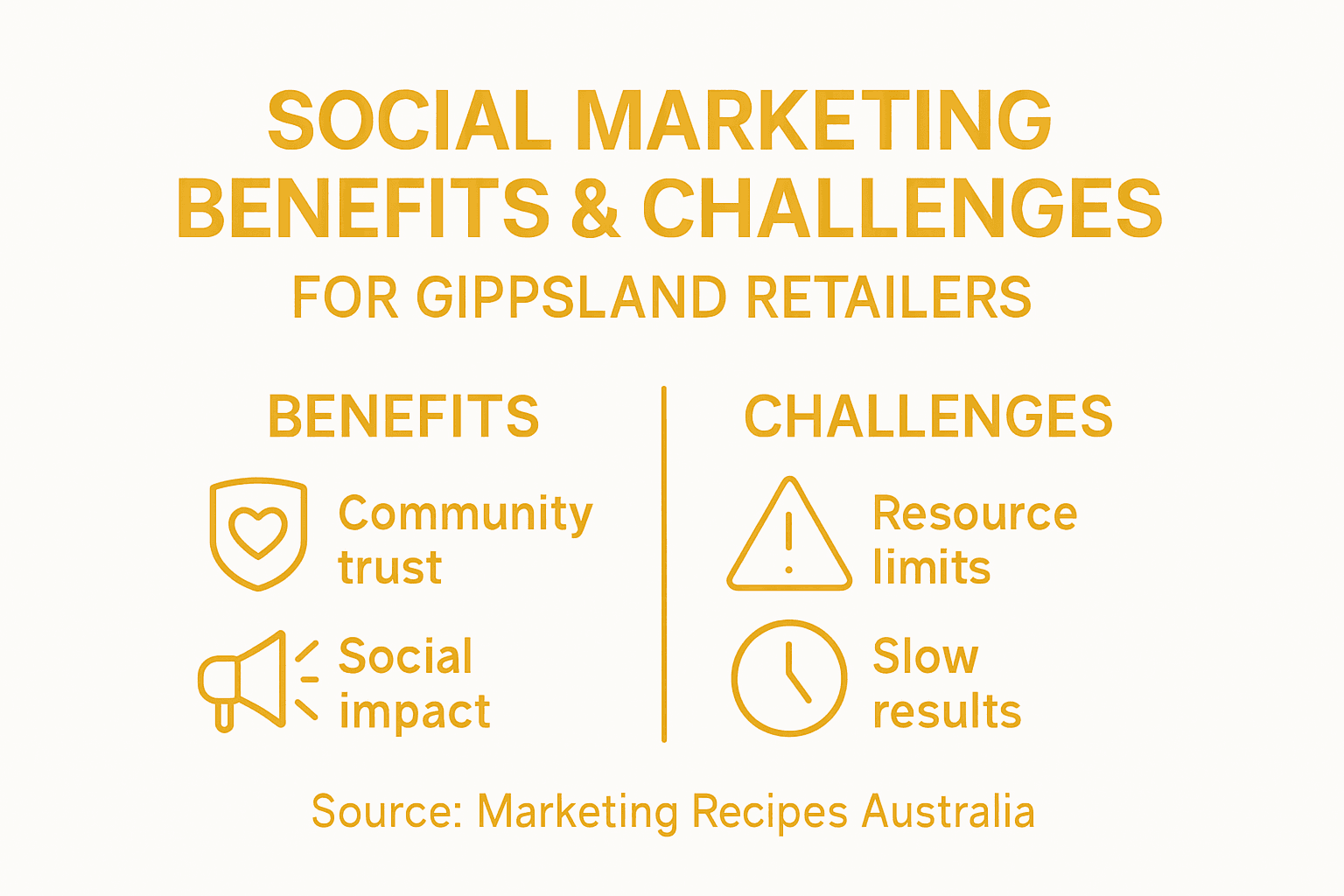
Explore how social marketing offers unique advantages and faces distinct obstacles for Gippsland retailers:
Benefit or Challenge | Short Description | Example for Gippsland Retailer |
Community Leadership | Builds reputation as positive change agent | Supporting local health campaigns |
Deep Engagement | Fosters real connections with local audience | Collaborating on safety programs |
Knowledge Gaps | Requires expertise in behaviour change | Training staff on social issues |
Resource Constraints | Limited marketing budgets and time | Prioritising one impactful campaign |
Pro tip: Start small by identifying one specific local social issue your business can genuinely support, and develop a focused, authentic strategy around addressing that challenge.
Empower Your Gippsland Business with Social Marketing Strategies
The article highlights the challenge faced by Gippsland retailers to connect meaningfully with their local communities through social marketing. Key pain points include limited budgets, the need for specialised knowledge, and crafting authentic, behaviour-focused campaigns that deliver long-term social impact. If you want to overcome these hurdles and turn social marketing into a powerful tool for building community trust and brand loyalty, the right expertise is essential. Concepts like consumer-centred design and ethical implementation should guide your approach to create genuine, sustainable change.
At Marketing Recipes Australia, we understand how critical it is to craft tailored strategies that resonate with regional audiences. Combining our 30+ years of experience in video marketing, content creation, and digital tools, we help local businesses in Gippsland implement authentic social marketing initiatives that speak to community values. Whether through engaging videos, strategic social media management, or targeted email campaigns, our holistic ‘kitchen-inspired’ approach brings your social marketing goals to life.

Take the next step today and transform your community engagement efforts into lasting business success. Explore how tailored digital marketing can amplify your social marketing impact by visiting Marketing Recipes Australia. Discover practical insights and personalised solutions to address Gippsland’s unique challenges with effective social marketing strategies.
Frequently Asked Questions
What is social marketing?
Social marketing is an approach that applies marketing principles to influence behaviours for social good, addressing societal challenges like public health and environmental issues.
How does social marketing differ from traditional marketing?
Unlike traditional marketing, which aims to sell products for profit, social marketing focuses on behaviour change to improve community wellbeing and social outcomes.
What are the key principles of social marketing?
Core principles of social marketing include a consumer-centred design, evidence-based strategies, ethical practices, comprehensive research, and ongoing measurement of impact.
What types of issues can social marketing address?
Social marketing can target a wide range of social issues, including public health (e.g., smoking cessation), community safety (e.g., road safety education), and environmental sustainability (e.g., climate change awareness).
Recommended