How to Create Accounting Marketing Strategy for Local Impact
- Eddie The Chef

- 3 days ago
- 11 min read

Finding local clients in Gippsland can feel challenging, especially when you want your accounting firm to stand out in a crowded market. For firms in Victoria, attracting the right clients starts with a clear understanding of their needs and where they spend their time. By focusing on tailored messaging and a multi-channel approach, you can connect with local businesses and professionals in ways that build genuine trust and drive new opportunities.
Table of Contents
Quick Summary
Key Insight | Explanation |
1. Define your target audience | Identify specific segments in your community that need your services. Understand their industries, demographics, and pain points. |
2. Use the right marketing channels | Focus on channels your target audience uses, such as social media, local events, and email marketing, for effective outreach. |
3. Create tailored content | Develop content addressing local audience challenges to demonstrate your expertise and build trust effectively. |
4. Execute campaigns precisely | Launch targeted campaigns using one channel at a time, focusing on specific audience segments and clear messages. |
5. Measure and refine strategies | Consistently track key metrics to evaluate campaign performance and adjust strategies based on data and client feedback. |
Step 1: Define your local accounting audience
Before you can market your accounting services effectively, you need to understand who you’re actually trying to reach. This isn’t about casting a wide net and hoping someone bites. It’s about identifying the specific people and businesses in your community who genuinely need what you offer and can benefit most from your expertise.
Start by thinking about the clients you already have. What do they have in common? Are they small business owners, tradespeople, professionals, or a mix? Do they operate in specific industries like agriculture, construction, or retail? Understanding audience behaviour and communication strategies helps you craft messages that actually resonate with the people you serve. Your existing clients are your first clue. They represent your ideal customer profile, and they can teach you volumes about who else in Gippsland might need your services.
Next, consider the geographic and demographic factors that matter. Gippsland has unique characteristics. You might serve farmers and agricultural businesses, tradies running construction crews, or professionals like dentists and accountants themselves. Each group has different needs, concerns, and ways of communicating. A busy farm owner doesn’t have time for lengthy explanations, whilst a young entrepreneur starting their first business might need more guidance and reassurance. Age, business size, industry type, and growth stage all matter when defining your audience.
Don’t forget to think about your audience’s challenges and motivations. What keeps them awake at night? Are they worried about tax compliance, cash flow management, or growth planning? Are they struggling to understand their financials or worried they’re paying too much tax? When you understand what genuinely matters to them, you can position your services as the solution to their real problems, not just another accounting service.
Write down three to five specific audience segments you want to target. Be detailed. Instead of “small business owners,” try “owner operator tradies with 5-10 staff in the construction sector” or “established agricultural operations with seasonal income.” The more specific you are, the easier it becomes to craft marketing messages that speak directly to them.
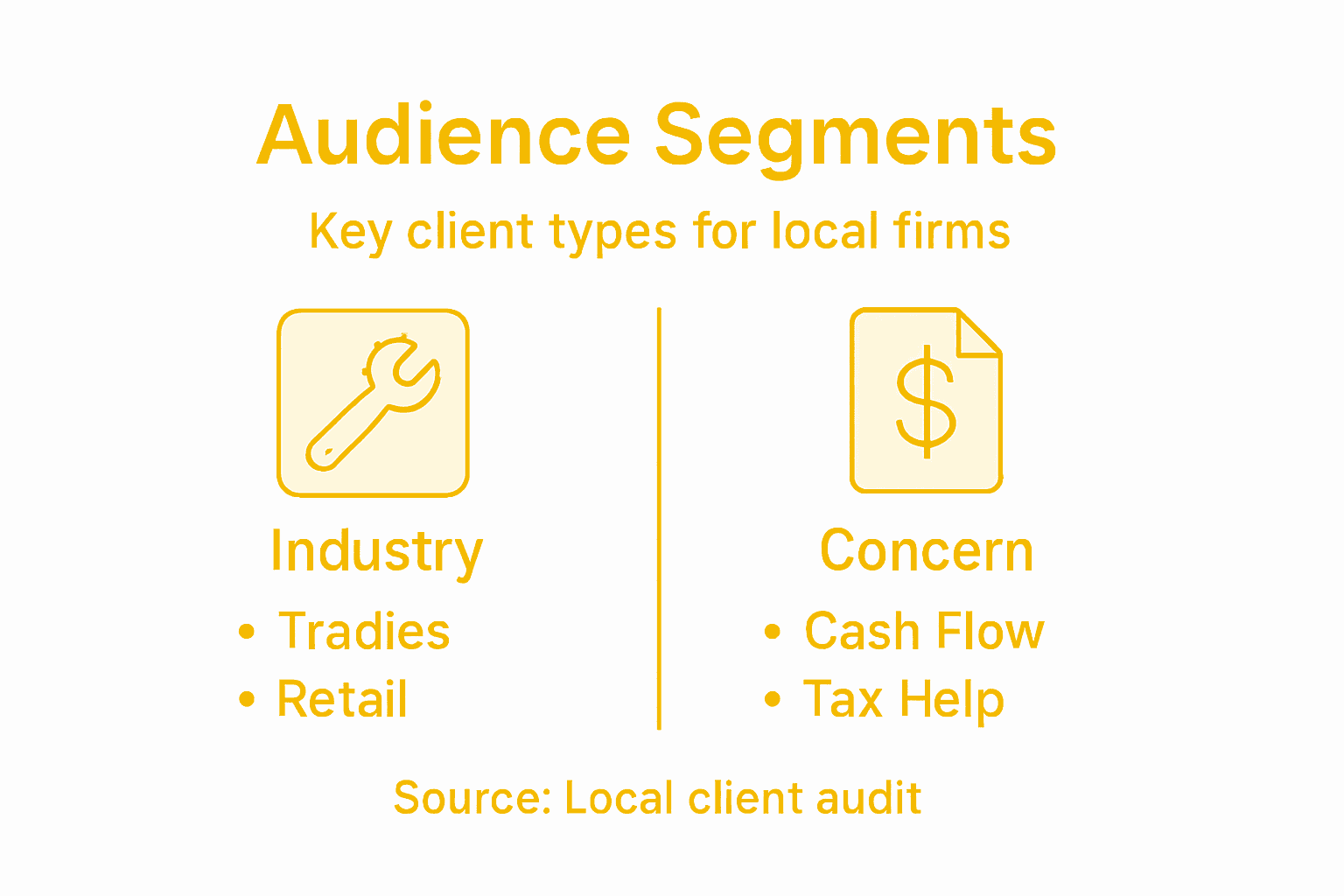
Here’s a comparison of key audience segments and their primary accounting challenges in Gippsland:
Audience Segment | Typical Industry | Main Accounting Concern |
Owner operator tradies (5-10 staff) | Construction | BAS, payroll, cash flow |
Established agricultural operations (seasonal income) | Farming/Agriculture | Tax timing, seasonal cash management |
Young professionals starting a business | Professional Services | Business setup, compliance |
Retail business owners | Retail | Inventory, GST, sales reporting |
Mature local businesses | Various industries | Succession planning, growth advice |
Professional tip Map out one conversation with a favourite existing client to identify common themes in their problems, industry, and decision-making style. Use this as your template for reaching similar prospects in your local area.
Step 2: Identify standout marketing channels
Not every marketing channel works equally well for accounting services in Gippsland. Some will reach your ideal clients consistently, whilst others will drain your budget with minimal return. This step is about identifying which channels genuinely connect with the specific audiences you defined earlier.
Start by mapping out where your target audience actually spends their time. If you’re targeting tradies and construction business owners, they’re likely on Facebook and LinkedIn, attending local business events, and reading industry publications. If you’re after agricultural clients, you might find them at regional farming networks, industry conferences, and online forums specific to their sector. The key is matching your audience’s habits with channel availability. Digital channels including social media and local search optimisation work brilliantly for reaching local clients, but only if you’re using platforms where they’re actively looking.
Consider both digital and offline channels together. Your website optimised for local search can attract clients searching “accountant near me” or industry specific terms. Social media lets you build ongoing relationships and demonstrate expertise. Email marketing keeps you connected with past and current clients. But don’t overlook traditional methods either. Local business events, sponsorships, and networking still carry enormous weight in Gippsland communities where personal relationships matter deeply. The most effective approach combines multiple channels strategically, not relying solely on one method.

Test each channel with a small investment first. Don’t commit your entire marketing budget to Facebook ads if you haven’t validated that your audience responds there. Try a modest local SEO campaign, experiment with a LinkedIn content series, sponsor a small community event. Track which channels actually bring qualified leads through your door. Some channels will surprise you. You might discover that referrals from local business associations generate more quality leads than expensive digital advertising.
Narrow down to your top three channels based on this testing. These become your focus areas where you’ll develop consistent, authentic presence. You can always add channels later, but starting focused prevents overwhelm and increases your chances of doing something well rather than many things poorly.
Professional tip Create a simple tracking sheet documenting which channel brought each new client to you for the next three months. This real data beats guesswork and shows you exactly where to invest your marketing time and money.
This table summarises how different marketing channels can be matched to key local segments:
Channel Type | Ideal Segment | Engagement Strength |
Facebook Groups | Tradies, small business owners | High for local networking |
Professionals, business owners | Moderate, strong for B2B | |
Local Events | All local clients, especially agribusiness | High for building relationships |
Industry Forums | Agriculture, niche sectors | Useful for targeted advice |
Community Sponsorships | Retailers, established businesses | Builds visibility, trust |
Step 3: Craft tailored content that connects
Content is how you show your accounting expertise to potential clients without being pushy or salesy. It’s the bridge between your firm and the people who need you. But generic content won’t cut it. Your content needs to speak directly to the concerns and situations of your local Gippsland audience.
Start by identifying the specific problems your audience faces. A tradie struggling with cash flow management has different concerns than a farmer dealing with seasonal income variations. A newly established business owner needs different guidance than someone running a mature operation. Understanding your audience’s needs through tailored messaging helps you create content that actually resonates. When you address real challenges with practical solutions, people pay attention.
Write content that demonstrates your local knowledge and expertise. Share blog posts about tax considerations specific to construction businesses in Victoria. Create newsletters discussing how agricultural businesses can manage cash flow through seasonal downturns. These aren’t generic accounting tips you’d find anywhere online. They’re insights that show you understand the particular landscape of your community. Educational materials and case studies built around local examples build genuine trust far more effectively than corporate sounding messaging.
Tell stories through testimonials and case studies. Show how you’ve helped a local tradesperson reduce their tax liability or helped a farm business simplify their record keeping. Real stories from real clients in your area carry weight. People connect with stories far more than they connect with feature lists. When a potential client sees someone like them getting genuine results, they start believing you might help them too.
Mix your content formats to keep things fresh. Some people prefer reading blog posts, others prefer watching videos, and some like downloading downloadable guides. Podcast interviews, email newsletters, social media updates, and webinars all serve different preferences. Effective storytelling through educational materials keeps your audience engaged across multiple touchpoints.
Professional tip Interview three of your best local clients about their biggest accounting challenges before writing your next piece of content. Their exact words and specific situations will make your content far more relatable and authentic than anything you’d write from behind a desk.
Step 4: Launch targeted campaigns effectively
A campaign is only as good as its execution. You can have brilliant strategy and compelling content, but if you don’t launch and manage your campaigns properly, they’ll fade into the background noise. This step is about taking action and making sure your message reaches the right people at the right time.
Start by selecting one of your top three channels and creating a focused campaign around a specific offering or message. Perhaps you’re promoting your tax planning services to tradies before tax time, or highlighting your agricultural accounting expertise during harvest season. Effective audience segmentation and marketing mix strategy ensures your message hits home. Don’t try to say everything to everyone. Pick one audience segment, one clear message, and one channel. Precision beats scatter gun approaches every time.
Set clear metrics before you launch. How will you measure success? Track the number of inquiries received, the cost per lead, conversion rates, and ultimately new clients acquired. If you’re running a Facebook ad campaign targeting construction business owners, you might aim for a cost per lead under fifty dollars. If you’re sponsoring a local business event, count how many qualified conversations you have. Data tells you what’s working and what isn’t.
Run your campaign for at least four weeks before making judgements. Marketing takes time to build momentum. Some channels show results immediately, whilst others need time to compound. During this period, monitor your metrics weekly. Are people engaging with your content? Are inquiries coming through? Are they the right type of prospect?
Adjust based on what you learn. If your Facebook ads aren’t converting, try different audience targeting or refine your ad copy. If your email campaign gets strong opens but low click through rates, your subject line works but your message needs clarity. Testing and refinement based on performance metrics is how campaigns evolve from okay to outstanding.
Professional tip Set up a simple spreadsheet tracking your campaign start date, budget spent, leads generated, and conversion rate before you launch anything. Review it every Friday to spot trends early rather than waiting months to realise something isn’t working.
Step 5: Measure results and refine your approach
Numbers don’t lie. If you’re not measuring what your marketing actually delivers, you’re flying blind. This step separates firms that grow consistently from those that spend money hoping something works. You need to know what’s happening with your campaigns, what’s generating actual results, and where to invest your effort next.
Start by identifying the key metrics that matter for your business. Marketing analytics tools help track engagement, conversion rates, and ROI across your campaigns. If you’re running a local SEO campaign, measure how many people visit your website from local searches and how many become inquiries. If you’re using email marketing, track open rates, click through rates, and which emails actually convert prospects into clients. For social media, look beyond vanity metrics like follower counts. Focus on meaningful engagement and lead generation.
Compare your results against what you expected. When you launched your campaign, you set targets. Perhaps you aimed for ten qualified inquiries per month from your Facebook ads at a cost of fifty dollars each. Now you can see if you hit that mark. Some campaigns will outperform your expectations, whilst others will underperform. Both tell you something valuable. Success shows you what resonates with your audience. Underperformance tells you to adjust your approach.
Don’t wait six months to evaluate. Check your metrics monthly, ideally weekly for active campaigns. This keeps you responsive rather than reactive. If something isn’t working after two weeks, you can adjust quickly rather than wasting another four weeks on an ineffective approach. Track which audience segments respond best to which messages on which channels.
Regular evaluation and continuous refinement of your marketing efforts align your campaigns with your actual business goals. Use customer feedback too. Ask new clients how they found you. What message resonated? What made them choose your firm? This qualitative feedback combined with quantitative metrics creates a complete picture of what’s working.
Update your marketing plan based on these insights. Double down on what works. Cut what doesn’t. Shift your budget toward your best performing channels. Your accounting marketing strategy should evolve constantly as you learn more about your local audience and what drives results.
Professional tip Create a simple one page monthly marketing report showing your top three metrics for each active campaign alongside your targets. Review this with your team every month to spot trends and decide what to keep, scale, or stop doing.
Elevate Your Local Accounting Marketing Strategy with Proven Digital Expertise
The challenge for accounting firms in Gippsland lies in crafting tailored marketing strategies that connect directly to local business needs and stand out across the right channels. From defining specific audience segments like tradies and agricultural operators to launching targeted campaigns and measuring real results this article highlights key pain points such as overcoming marketing overwhelm and building authentic community engagement through content that resonates.
Marketing Recipes Australia specialises in addressing these exact hurdles with a 30+ year history of success helping regional businesses grow. We combine strategic consulting, creative content production like video marketing, and multi-channel digital solutions into a focused menu designed to build authentic local connections and drive leads. Our approach ensures your accounting firm reaches the right clients with clarity and impact without wasting budget on ineffective tactics.
Discover how our tailored digital marketing services can fuel your accounting marketing strategy.

Ready to turn your local accounting marketing challenges into growth opportunities Let our experienced team create a personalised plan that targets your ideal audience through proven channels with engaging content proven to convert. Visit Marketing Recipes Australia today and start building campaigns that deliver long-term results for your firm.
Frequently Asked Questions
How do I define my local accounting audience?
Begin by analysing your current clients to identify common characteristics such as industry, size, and specific needs. Write down three to five audience segments, being as detailed as possible, to gain a clearer focus for your marketing efforts.
What marketing channels work best for local accounting services?
Identify where your target audience spends their time, such as Facebook, LinkedIn, or local business events. Focus on 2-3 channels based on this research to establish a strong, authentic presence and increase engagement over the next few months.
How can I create content that connects with my local audience?
Craft content that addresses the specific challenges your audience faces, incorporating local knowledge and examples. Consider formats like blog posts, videos, or case studies, and aim to produce at least one piece of tailored content each month.
What should I track to measure the success of my accounting marketing campaigns?
Focus on key metrics such as the number of inquiries generated, cost per lead, and conversion rates. Set up a tracking sheet to review these metrics weekly so you can quickly identify trends and make adjustments if necessary.
How often should I refine my marketing strategy?
Regularly evaluate your marketing efforts at least once a month, paying close attention to performance metrics and client feedback. Use these insights to adjust your campaigns and allocate your budget effectively, aiming for continuous improvement over time.
Recommended
Comments