What Is Email Marketing Strategy – Real Results Locally
- Eddie The Chef

- 1 day ago
- 7 min read

Running a local business in Gippsland means finding practical ways to connect with real customers every week. Email marketing delivers direct communication, helping retail and hospitality owners stay top of mind and drive repeat sales. By focusing on customer segmentation and meaningful content, you can create campaigns that feel genuinely personal and impactful. This guide unpacks the essential principles behind successful email marketing so you build trust, comply with Australian laws, and see measurable growth.
Table of Contents
Key Takeaways
Point | Details |
Customer Segmentation | Tailor messaging by dividing your email list into specific groups based on demographics or engagement levels. |
Content Quality | Ensure emails provide genuine value, such as informative updates or exclusive offers, to keep your audience engaged. |
Compliance Awareness | Follow legal frameworks like the Spam Act 2003 to ensure explicit consent and respect consumer preferences in your email marketing. |
Continuous Improvement | Regularly track metrics such as open rates and click-through rates to refine your email marketing strategy effectively. |
Email Marketing Strategy – Core Principles Explained
An effective email marketing strategy requires strategic planning and understanding how to connect with customers digitally. For local businesses in Gippsland, this means developing targeted approaches that speak directly to your regional audience. Strategic marketing principles emphasise aligning communication tactics with clear business objectives and customer needs.
The core principles of email marketing revolve around several key elements. First, customer segmentation allows businesses to personalise messaging and increase relevance. By dividing your email list into specific groups based on demographics, purchasing history, or engagement levels, you can craft more targeted communications. Second, content quality matters immensely. Your emails should provide genuine value, whether through informative updates, exclusive offers, or helpful insights that solve customer problems.
Measurement and continuous improvement form another critical principle. Tracking metrics like open rates, click-through rates, and conversion rates enables businesses to refine their approach systematically. Marketing integration techniques highlight the importance of viewing email as part of a broader marketing ecosystem, not an isolated channel.
Pro tip: Create a segmentation strategy by reviewing your customer database and identifying 3-5 distinct groups based on meaningful characteristics that impact purchasing behaviour.
Types Of Email Campaigns For Small Business
Small businesses in Gippsland have multiple email campaign types to choose from, each serving distinct marketing objectives. Email marketing strategies enable targeted communication that can significantly boost customer engagement and sales performance across different business sectors.
The primary email campaign types include welcome emails, which introduce new subscribers to your brand and set expectations. Newsletters represent another crucial category, providing regular updates, industry insights, and valuable content that keeps your audience informed and connected. Promotional campaigns are designed to drive immediate sales by sharing special offers, discounts, or limited-time deals that create a sense of urgency and encourage quick customer action.
Additionally, businesses can leverage re-engagement campaigns to reconnect with dormant subscribers, product announcement emails to highlight new offerings, and event invitation emails to drive attendance at workshops, sales, or special gatherings. Marketing campaign techniques emphasise the importance of tailoring these campaign types to specific customer segments and business goals, ensuring maximum relevance and effectiveness.
Compare the main types of email campaigns used by small businesses:
Campaign Type | Primary Goal | Typical Content |
Welcome Email | Onboard new subscribers | Brand intro, what to expect |
Newsletter | Engage and inform | Updates, news, tips |
Promotional | Drive immediate sales | Offers, discounts |
Re-engagement | Revive inactive list | Special reactivation offers |
Event Invitation | Boost attendance | Event details, RSVP links |
Pro tip: Create a quarterly email campaign calendar that maps out different campaign types, aligning them with your business seasonality and key customer lifecycle moments.
How Email Marketing Strategies Actually Work
Email marketing strategies operate through a sophisticated process of targeted communication and strategic engagement. Direct marketing techniques enable businesses to reach specific audience segments with precision and personalisation, transforming how regional businesses connect with potential customers.
The core mechanism involves several critical steps. Audience segmentation is the first key element, where businesses divide their contact list into specific groups based on characteristics like purchasing behaviour, demographics, or engagement history. This allows for highly tailored messaging that resonates with each unique customer group. Consent and permission form another fundamental principle, ensuring businesses only communicate with individuals who have explicitly agreed to receive marketing communications.

Technology plays a crucial role in making email marketing strategies effective. Automated email platforms track critical metrics like open rates, click-through rates, and conversion performance, providing real-time insights that help businesses refine their marketing approach. These systems enable sophisticated tracking, allowing businesses to understand customer interactions, adjust content in real-time, and create increasingly targeted campaigns that drive meaningful engagement.
Pro tip: Invest in an email marketing platform that offers advanced segmentation and analytics capabilities to continuously improve your communication strategy.
Australian Laws And Email Compliance Essentials
Email marketing in Australia operates under strict legal frameworks designed to protect consumer privacy and ensure ethical digital communication. Email marketing regulations mandate specific requirements that businesses must follow to maintain legal compliance and consumer trust.
The primary legislation governing email marketing includes the Spam Act 2003 and the Privacy Act 1988. These laws establish critical compliance standards such as obtaining explicit consent before sending marketing communications, providing clear sender identification, and including a straightforward unsubscribe mechanism in every email. Businesses must ensure that recipients have either express consent (direct permission) or inferred consent (existing business relationship) before sending marketing emails.
Key compliance essentials involve transparent communication practices. Australian email marketing laws require businesses to clearly identify themselves, avoid misleading content, and respect consumer communication preferences. This means including accurate business contact information, ensuring email content matches the subject line, and immediately honouring unsubscribe requests within five business days. Penalties for non-compliance can be significant, with potential fines up to $2.22 million for serious or repeated breaches.
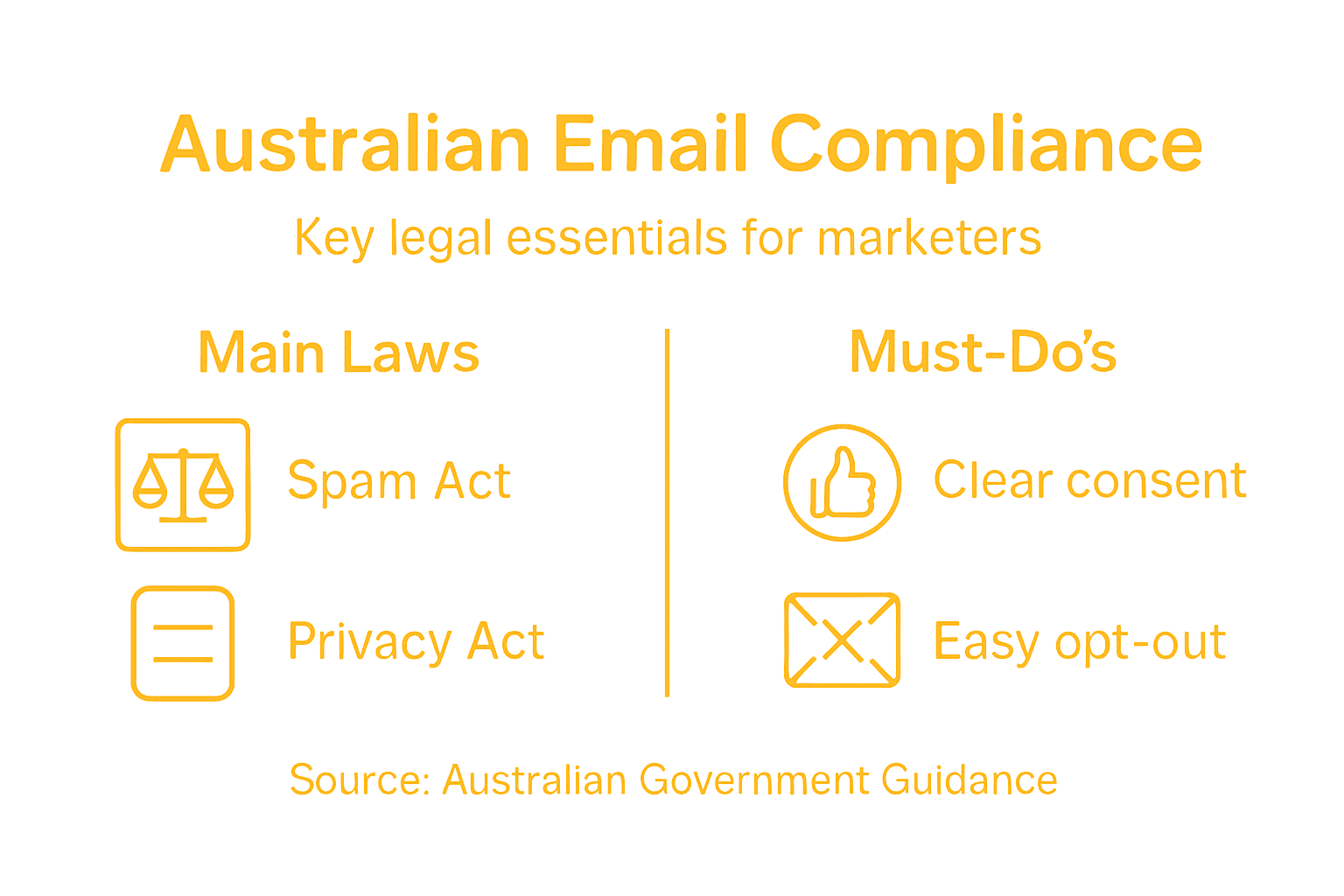
Here’s a summary of the main Australian email marketing laws and their business implications:
Legislation | Key Requirement | Impact on Business |
Spam Act 2003 | Explicit consent before emailing | Reduces risk of legal fines |
Privacy Act 1988 | Protects personal information | Increases customer trust |
Unsubscribe Rule | Simple opt-out in every email | Maintains compliance easily |
Sender ID Rule | Clear business identification | Builds brand credibility |
Pro tip: Develop a comprehensive consent and record-keeping system that documents how and when each contact provided marketing permission to ensure full legal compliance.
Common Pitfalls And How To Avoid Them
Email marketing success depends on navigating potential challenges that can derail your communication strategy. Email marketing legal challenges reveal several critical pitfalls that regional businesses must carefully manage to maintain compliance and customer trust.
One significant issue is improper consent management. Many businesses accidentally breach regulations by sending emails without clear, documented permission. This includes assuming past interactions constitute consent or failing to maintain accurate records of subscriber agreements. Another common mistake involves poorly designed unsubscribe mechanisms that are difficult to find or complex to use, which can frustrate recipients and potentially trigger legal complications. Businesses must ensure their unsubscribe process is straightforward, immediate, and functional across all devices.
Content-related pitfalls can also compromise email marketing effectiveness. Misleading subject lines, inconsistent messaging, and overly aggressive sales language can damage brand reputation and trigger spam filters. Regional businesses should focus on creating transparent, value-driven content that genuinely serves the recipient’s interests. This means aligning email content precisely with subscriber expectations, providing clear value, and maintaining a consistent, professional tone that reflects the local business context.
Pro tip: Implement a comprehensive consent tracking system that automatically logs subscriber permissions and preferences, ensuring you maintain a clean, legally compliant email list.
Transform Your Local Email Marketing Strategy with Proven Expertise
Struggling to unlock the real potential of your email marketing campaigns in Gippsland or other regional areas? This article highlights key challenges like audience segmentation, compliance with Australian laws, and creating engaging content that truly resonates. If you want to avoid common pitfalls and build genuine customer connections through tailored, legally compliant email strategies then expert guidance is essential. Our approach focuses on clear planning, personalised messaging, and continuous improvement to generate measurable results.

Take action today and partner with Marketing Recipes Australia – your dedicated digital marketing agency specialising in regional business growth. Discover how our unique “kitchen-inspired” method blends video marketing, creative content, and expert email campaign management to boost engagement and sales. Visit our landing page to learn how you can develop a comprehensive email marketing strategy that not only complies with laws but delivers real local results. Start enhancing your customer relationships and growing your business now.
Frequently Asked Questions
What are the key principles of an effective email marketing strategy?
An effective email marketing strategy is based on customer segmentation, high-quality content, and measurement for continuous improvement. It involves tailoring messages to specific audience segments and ensuring that emails provide genuine value to recipients.
What types of email campaigns should small businesses consider?
Small businesses should consider various types of email campaigns, including welcome emails, newsletters, promotional campaigns, re-engagement campaigns, and event invitations. Each type serves a unique purpose and should align with specific business goals.
How can I measure the success of my email marketing strategy?
You can measure the success of your email marketing strategy through key metrics such as open rates, click-through rates, and conversion rates. These metrics provide insights into how well your emails are engaging your audience and helping you achieve your objectives.
What are the compliance essentials for email marketing in Australia?
Compliance essentials for email marketing in Australia include obtaining explicit consent from recipients, providing clear sender identification, and including a simple unsubscribe mechanism in every email, as mandated by the Spam Act 2003 and the Privacy Act 1988.
Recommended
Comments