What Is a Digital Marketing Business in Australia?
- Eddie The Chef

- Jan 22
- 15 min read

Running a retail shop or hospitality venue in Gippsland means you need more than just a good product to compete. Creating a strong online presence is as crucial as your storefront, helping locals and visitors alike find your business wherever they search. For small businesses, choosing an affordable digital marketing solution unlocks tools to connect with customers through channels like social media, email, and search engines. This guide explains how a digital marketing business in Australia helps you reach and engage customers online while driving sales and supporting sustainable growth.
Table of Contents
Key Takeaways
Point | Details |
Digital Marketing Definition | A digital marketing business connects local companies with customers through online channels, enhancing their visibility and engagement. |
Importance of Measurement | Unlike traditional marketing, digital marketing focuses on data-driven strategies, allowing businesses to track performance and optimise efforts effectively. |
Service Variety | Digital marketing agencies offer a range of services, including social media management, SEO, and email marketing, tailored to specific business needs. |
Regional Advantages | Digital marketing helps regional businesses compete more broadly, providing cost-effective and measurable methods to attract customers beyond their local area. |
Defining a Digital Marketing Business in Australia
A digital marketing business in Australia is fundamentally about connecting other businesses with their customers through online channels. Think of it like running a restaurant—you wouldn’t just cook great food and hope people find you. You’d tell locals about your specials, keep regular customers coming back, and make sure your storefront looks inviting. Digital marketing businesses do exactly that, but online. They help retail shops, hospitality venues, and other local enterprises create a strong presence where their customers actually spend time: social media, search engines, email inboxes, and websites.
What makes a digital marketing business different from traditional marketing is the focus on data and measurement. Instead of running a newspaper ad and hoping for the best, digital marketers track exactly who’s visiting your website, which posts people engage with, and which campaigns actually drive sales through your door. They work across multiple channels—from managing your social media presence to optimising your Google search results, crafting email campaigns that keep customers informed, and creating website content that converts browsers into buyers. For businesses in Gippsland, this means having someone who understands both the online world and your local market. A good digital marketing business takes time to understand your specific customers, your competitors down the street, and what makes your hospitality venue or retail shop unique.
From a legal standpoint in Australia, operating a digital marketing business requires proper registration and compliance. You’ll need an Australian Business Number (ABN) and a registered business name with ASIC if you’re trading as a company. This matters whether you’re a freelancer operating from home or a full-fledged agency. You’ll also need to understand your taxation obligations, including GST registration if your turnover reaches the threshold, and PAYG withholding if you employ staff. The Australian Business Register keeps your details up to date and current. What’s crucial here is that legitimate digital marketing businesses operate transparently—they’re registered, they pay their taxes, and they can provide proper invoices and contracts. When you’re choosing someone to handle your online marketing, checking their ABN and asking about their registration status tells you they’re serious about their business, just as you’d expect from any professional service you hire.
At its core, a digital marketing business transforms how local companies like yours compete in the modern marketplace. Rather than relying purely on foot traffic and word of mouth, you gain access to customers searching online right now, people scrolling social media during their lunch break, and locals who want to know your operating hours or menu before they visit. Marketing Recipes Australia approaches this with a kitchen-inspired philosophy—combining strategic planning, creative content, and technical execution into one comprehensive service. Whether it’s video content that showcases your best dishes, email campaigns that keep regulars informed about new offerings, or social media management that builds genuine community, it’s all designed to grow your business affordably and measurably.
Pro tip: When evaluating digital marketing businesses for your retail or hospitality operation, ask them directly what they’ll measure and how often they’ll report results—whether that’s website visits, social media engagement, or actual customer sales from their campaigns.
Types of Digital Marketing Services Offered
Digital marketing businesses don’t offer just one service—they offer a menu of solutions tailored to your specific needs. For a small retail shop or hospitality venue in Gippsland, understanding what’s available helps you choose what actually matters for your business. The core services fall into several categories, and most Australian digital marketing agencies mix and match them based on what will drive real results for you. Think of it like ordering from a restaurant: you don’t need every dish on the menu, just the ones that satisfy your appetite.
Social media management and content creation tops the list for most local businesses. This involves managing your presence across Facebook, Instagram, LinkedIn, and other platforms where your customers actually spend time. A good social media strategy means posting consistently, responding to comments and messages, and creating content that encourages people to engage with your business. Then there’s search engine optimisation (SEO), which helps your website appear higher in Google search results when locals are looking for what you offer. Search engine marketing (SEM) and Google Ads complement this by running paid ads that show up in search results immediately. Your website itself needs content creation and web design—having a site that looks professional, loads quickly, and clearly tells visitors what you do and why they should choose you over competitors. Email marketing keeps your existing customers informed about specials, new menu items, or upcoming events. Brand marketing and strategy ties everything together by making sure your message is consistent across all channels and genuinely reflects who you are as a business.

Beyond these foundational services, many digital marketing businesses offer marketing analytics and insights, which is where the magic really happens. Using tools like Google Analytics, they track exactly how many people visit your site, where they come from, what pages they spend time on, and whether they’re actually buying from you or booking a table. This data transforms marketing from guesswork into strategy—you know what’s working and what isn’t. Some agencies also handle mobile marketing to reach customers on smartphones, brand development to create a cohesive visual identity, and digital campaign execution that coordinates all these elements into one focused effort. For hospitality and retail, video content is increasingly critical, and many agencies now offer video production, editing, and management across social platforms.
What makes choosing services manageable is understanding your actual business goals. Are you trying to get more foot traffic through your restaurant door? Then social media, local SEO, and email to past customers might be your priority. Want to expand online ordering or takeaway? That’s website optimisation and paid search ads. Building long-term brand recognition in your region? That calls for consistent content creation, social media, and strategic brand messaging. Most legitimate digital marketing businesses will talk through your specific situation before throwing everything at you. They’ll ask questions like: who’s your ideal customer, what’s your budget, and what matters most—visibility, sales, bookings, or customer loyalty? The answer shapes which services make the most sense for your business right now.
Pro tip: Ask any digital marketing business to explain which three services they’d prioritise for YOUR specific business first, and insist they show you examples of results they’ve achieved for similar retail or hospitality clients before signing on.
Here is a comparison of key digital marketing services for SMEs in Australia:
Service Type | Main Objective | Typical Cost Range | Core Business Impact |
Social Media Management | Build online audience | $200-$800/month | Increases customer engagement |
SEO | Improve search visibility | $500-$2,000/onetime or monthly | Boosts website traffic |
Email Marketing | Retain & inform customers | $100-$500/month | Drives repeat business |
Paid Advertising (SEM) | Immediate customer reach | $200-$1,500+/campaign | Generates quick leads or sales |
Web Design & Content | Enhance user experience | $1,000-$5,000/onetime | Converts visitors to customers |
How Digital Marketing Benefits Regional Businesses
For retail shops and hospitality venues in Gippsland, the biggest advantage of digital marketing is simple: it removes the geographic barrier that once limited your reach. Twenty years ago, your customers were basically limited to people within driving distance or those who happened upon your storefront. Today, someone searching for a great café or specialty retailer on their phone can find you from anywhere, and digital marketing makes sure they actually do find you. Reliable internet connectivity enables regional businesses to expand beyond local markets and participate fully in the digital economy. This fundamentally changes how regional businesses compete. You’re no longer limited to competing against the three other hospitality venues down the street. You’re competing regionally, but you’re also accessible to anyone online. That’s not a disadvantage—it’s your secret weapon if you use it right.
Another crucial benefit is cost-effectiveness compared to traditional marketing. Running consistent newspaper ads, local radio spots, and billboards costs serious money, and it’s hard to measure whether they actually work. Digital marketing lets you start small, test what resonates with your audience, and scale up only what’s working. You can run a Facebook ad campaign for $200 and track exactly how many people clicked through and whether they booked a table or made a purchase. You can send an email to past customers for almost nothing and see how many opened it and came back. This is particularly powerful for small businesses with tight budgets. You’re not throwing money at broad marketing hoping some of it sticks. You’re testing, measuring, and investing more in what delivers results. For a restaurant owner or retail manager in Gippsland watching every dollar, that accountability matters tremendously. You’ll know whether social media is driving sales or if your email list is actually worth maintaining.
Digital marketing also builds genuine customer relationships in ways traditional marketing never could. When you respond to comments on your social media posts, share behind-the-scenes content, or send personalised emails about products you know a customer loves, you’re creating connection. People don’t just see you as a faceless business. They see the person running the café, the care that goes into your dishes, the story behind your retail shop. This builds loyalty that keeps customers coming back, and loyalty is far cheaper than constantly acquiring new customers. You’re also gaining direct feedback. Comments, messages, and reviews tell you exactly what customers love about your business and what frustrates them. That information is gold for improving your operations. A hospitality manager who reads reviews and actually responds to concerns is learning constantly what matters to their customers. That’s something a newspaper ad could never give you.
Perhaps most importantly for regional businesses, digital marketing creates a level playing field. A small family business in Gippsland with a smart social media strategy and solid website can compete for attention against much larger companies. They can build a loyal community online, generate word-of-mouth recommendations, and establish themselves as the local expert worth visiting. Digital channels reward creativity, authenticity, and genuine customer service more than they reward having the biggest marketing budget. Your personal touch, your local knowledge, and your unique offerings become actual competitive advantages rather than something that gets drowned out by corporate advertising. Regional business growth increasingly relies on digital strategies tailored to local market needs, which means the most successful regional businesses are those willing to embrace these tools and use them genuinely.
Pro tip: Start measuring something today: pick one metric that matters for your business—whether that’s website visits, social media engagement, or actual sales from digital sources—and track it for three months to see your real baseline before making any changes.
Understanding Costs and ROI for SMEs
When you’re running a small retail shop or hospitality venue, the question about digital marketing always comes down to money: How much does it cost, and will I actually get my money back? These are fair questions, and the honest answer is that digital marketing costs vary widely depending on what you do and how you do it. Some businesses spend $500 a month, others spend $5,000. The key difference isn’t usually the size of the business but rather the strategy, the channels chosen, and the level of service required. A café owner might start with social media management and basic SEO for $300 monthly, whilst a retail shop wanting to expand their online ordering might invest $1,500 to cover web design updates, paid advertising, and email campaigns. Strategic digital marketing budget allocation requires understanding how marketing activities produce measurable outcomes that support sustainable growth. The point is: there’s no single price tag. Your actual cost depends on what you’re trying to achieve and what you’re willing to invest to get there.
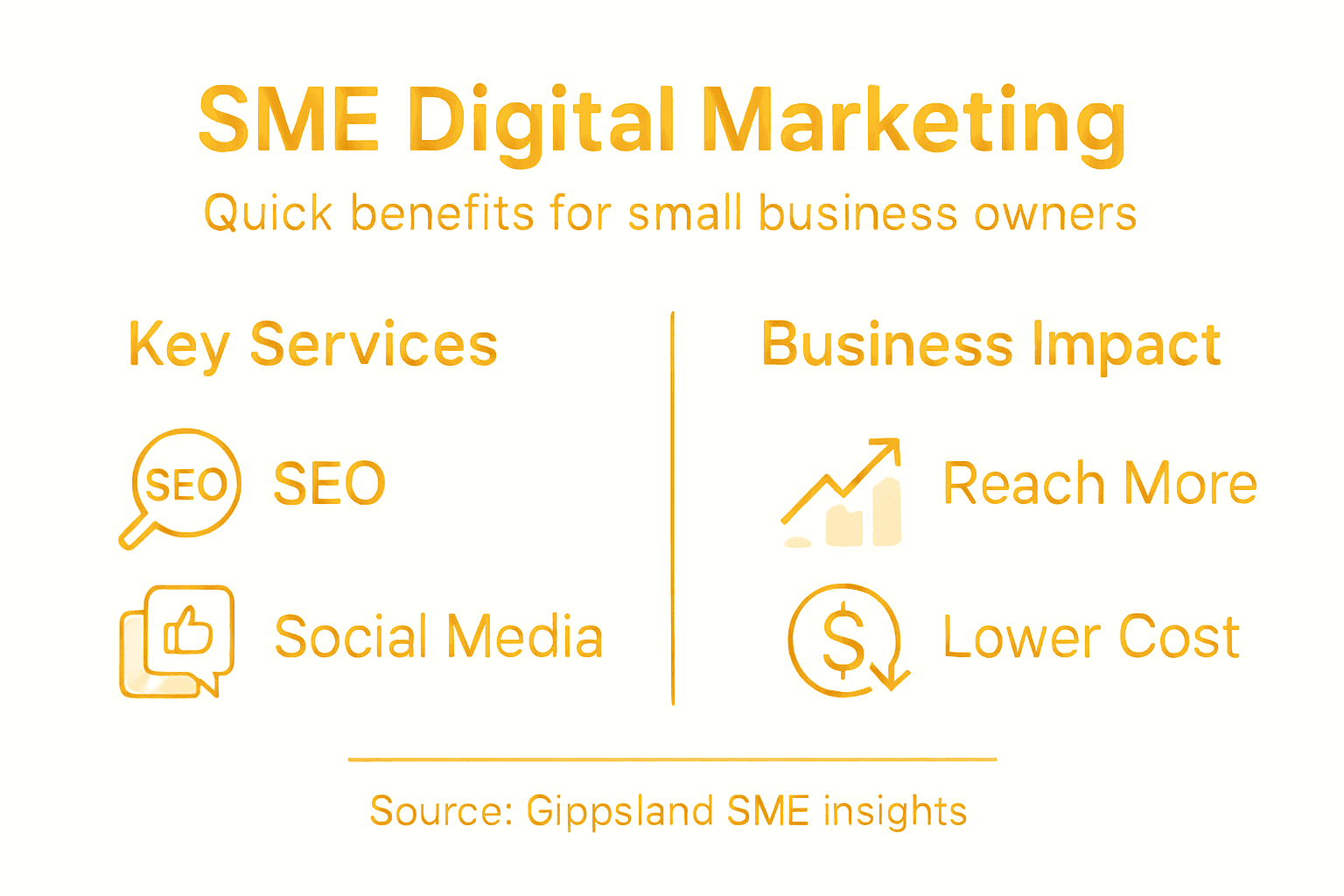
Calculating ROI for digital marketing isn’t as straightforward as traditional advertising, but that’s actually an advantage. With digital channels, you can track almost everything. If you spend $200 on a Facebook ad campaign, you can see exactly how many clicks it generated, how many people visited your website, and ideally, how many actually made a purchase or booked a table. Compare that to a $200 newspaper ad where you’re basically guessing whether it worked. Let’s say your restaurant spends $400 monthly on social media management and email campaigns, and that generates an extra $2,000 in weekly revenue from customers who found you online. That’s a five-fold return on investment in just one month. Your ROI is 400 per cent. Not all channels will perform that well, but if you’re measuring properly, you’ll know which ones do. The challenge is tracking consistently. You need to ask customers where they found you, use coupon codes or special links for different campaigns, and maintain records of your spending versus results. Without measurement, you’re flying blind.
Here’s what matters for real ROI calculation: start with baseline numbers. Before investing significantly in digital marketing, know your current situation. How many customers walk through your door weekly? What’s your average transaction value? How much do you currently spend on marketing of any kind? Then, after implementing digital marketing, track the same metrics monthly. Are customer numbers increasing? Is average transaction value going up? Are existing customers buying more frequently? Customer acquisition costs and retention directly impact whether your marketing investment produces growth. If you acquire customers but they never return, that’s poor ROI. If you spend heavily on attracting new customers but ignore keeping existing ones happy, you’re working twice as hard for the same result. The best ROI often comes from a mix: some spending on attracting new customers, but smart spending on email, loyalty programs, and social media engagement that keeps regular customers coming back and spending more.
For most SMEs in Gippsland, the realistic timeline to see meaningful ROI is three to six months. That’s not because digital marketing is slow. It’s because building trust online, getting ranked in search engines, and developing an audience on social media all take time. A Facebook post today might drive sales today, but consistent posting over weeks builds a real following that generates ongoing revenue. Your first month of digital marketing investment might show no obvious return. By month three or four, you’ll likely see patterns: certain types of posts get engagement, certain campaign types drive bookings, certain email sends perform better. By month six, you’ll have enough data to optimise confidently. You’ll know which channels are worth expanding and which aren’t working. This is why choosing a digital marketing partner who’s willing to commit to measurement and reporting matters so much. They should be showing you numbers every month, not just promises. They should be asking you about your goals upfront so you both know what success actually looks like.
Pro tip: Before committing to any digital marketing spend, establish three specific metrics you’ll track monthly: one about reach (like website visits or social media followers), one about engagement (like clicks or email open rates), and one about actual business impact (like sales or bookings attributed to digital channels).
Common Mistakes When Choosing a Digital Agency
Choosing the wrong digital agency can waste thousands of dollars and months of your time without delivering results. The mistake many small business owners make is treating digital marketing like a commodity. You wouldn’t choose a restaurant supplier purely based on the cheapest price without checking quality, and you shouldn’t choose a digital agency the same way. Yet that’s exactly what happens. A café owner gets three quotes and picks the cheapest option, only to discover six months later that the agency produced generic content, didn’t understand their local market, and delivered no measurable results. The damage isn’t just the wasted money. It’s the lost momentum. You’ve delayed building real digital presence and now you’re sceptical about whether digital marketing works at all. The truth is: digital marketing works brilliantly when done right, but it fails spectacularly when done wrong.
One of the biggest mistakes is choosing an agency that doesn’t understand your specific market and business goals. A generic digital agency that handles everything from tech companies to fitness studios to retail shops might lack the expertise your particular business needs. They treat your café like any other hospitality client, using templates and standard strategies that don’t reflect what makes you unique. This is why asking specific questions matters. Can they show you case studies of work they’ve done for similar businesses in your region? Do they understand local Gippsland markets, or are they operating nationally without real regional knowledge? Have they worked with hospitality venues or retail shops before? If they can’t answer these clearly, keep looking. Additionally, selecting agencies based solely on cost rather than expertise and strategic alignment often leads to ineffective campaigns and wasted resources. You need an agency that understands your business deeply enough to integrate digital solutions into your broader strategy, not just run random social media posts.
Another critical error is failing to establish clear measurement and reporting expectations upfront. Before signing any agreement, you should know exactly what the agency will measure, how often they’ll report to you, and what constitutes success. Will they track website visits, social media engagement, or actual sales? Will you get monthly reports, or do you have to chase them for updates? What happens if results aren’t appearing? Too many businesses discover three months in that the agency isn’t even measuring anything meaningful, or worse, they’re measuring vanity metrics like social media followers without any connection to actual business outcomes. A good agency should be comfortable sitting down with you beforehand and agreeing on specific, measurable goals. They should be willing to show you numbers regularly and explain what those numbers mean for your business. If an agency seems vague about measurement or talks mainly about getting you “visibility” without defining what that means, that’s a red flag.
A third mistake is choosing an agency that doesn’t understand the unique digital landscape and challenges of regional Australia. Inclusive digital marketing strategies must consider accessibility and regional connectivity challenges that impact how Gippsland customers engage online. An agency without understanding of these factors may develop strategies that don’t work for your actual customer base. They might build a website that’s slow to load on regional internet speeds, or create content strategies that ignore the specific platforms your customers use most. They might not understand the importance of mobile optimisation in rural areas, or how to leverage local search effectively. Before choosing an agency, ask how they approach regional digital marketing specifically. Have they worked with other regional businesses? Do they understand the connectivity challenges and how to work around them? Do they know how to optimise for local search, which is crucial when your customers are searching for things nearby?
Finally, be cautious of agencies that make unrealistic promises. If someone guarantees they’ll get you to the top of Google in 30 days, or promises a certain number of sales, they’re overselling. Digital marketing is real and produces measurable results, but it’s not magic. It takes time to build authority online, to grow an engaged audience, and to convert that attention into actual business. A trustworthy agency will be honest about timelines and realistic about what different strategies can achieve. They’ll say things like “Based on what we’ve seen with similar businesses, we’d expect social media engagement to start showing within four to eight weeks, with meaningful traffic growth by month three.” They won’t guarantee outcomes because too many factors outside their control affect results. If an agency seems too good to be true, it probably is.
Pro tip: Before meeting with any agency, write down your three most important business goals for digital marketing, your realistic monthly budget, and three questions about how they’d approach your specific business, then compare their answers across multiple agencies to see which one actually listens and understands your needs.
Below is a summary of common mistakes when choosing a digital agency and their real-world consequences:
Mistake | Why It Happens | Short-Term Consequence | Long-Term Impact |
Focusing only on lowest price | Cost concerns override quality | Poor content, wasted spend | Lost momentum, scepticism |
Ignoring regional expertise | Agency lacks local knowledge | Generic campaigns | Weak local market performance |
No clear measurement/reporting | Expectations not set upfront | Untracked results | No evidence of ROI |
Believing unrealistic promises | Guarantees sound attractive | Disappointment and frustration | Erosion of trust in digital |
Unlock Your Regional Business Potential with Expert Digital Marketing Solutions
The challenges of standing out in regional Australia, understanding your unique local market, and measuring real marketing impact are all part of what makes digital marketing both exciting and complex. If you are looking to transform your Gippsland retail shop or hospitality venue’s online presence into measurable growth then personalised support is essential. At Marketing Recipes Australia, we specialise in tailored strategies that combine creative content, video marketing, social media management, and data-driven insights to meet your specific goals and budget.

Take control of your digital marketing journey today by partnering with a team that understands the importance of local expertise and transparent measurement. Our kitchen-inspired approach means your business benefits from a full menu of solutions crafted to build genuine customer loyalty and drive sales. Discover how our video marketing and creative content services can showcase what makes your business unique while solidifying your search presence through effective SEO and social media management. Visit Marketing Recipes Australia now to start growing your business with a proven partner dedicated to regional Australian success.
Frequently Asked Questions
What is the primary role of a digital marketing business?
A digital marketing business connects other businesses with their customers through online channels such as social media, search engines, websites, and email, helping to build a strong digital presence.
How does digital marketing differ from traditional marketing?
Digital marketing focuses on data and measurement, allowing businesses to track visitor engagement, campaign effectiveness, and customer behaviour, whereas traditional marketing relies on broad metrics like impressions without detailed tracking.
What types of services do digital marketing businesses offer?
Digital marketing businesses typically offer a range of services, including social media management, search engine optimisation (SEO), content creation, email marketing, paid advertising, and analytics to enhance customer engagement and drive sales.
Why is digital marketing important for small businesses?
Digital marketing is essential for small businesses as it offers cost-effective strategies to reach a wider audience, build relationships with customers, and measure results precisely, providing an opportunity to compete effectively in a crowded marketplace.
Recommended
Comments