Advertising Agencies in Australia – What Locals Need
- Eddie The Chef

- Jan 23
- 13 min read
Finding new customers in Gippsland can feel challenging when bigger city brands seem to dominate every marketing channel. For local retailers who need more than just a logo or poster, the right agency partnership makes a real difference. Australian advertising agencies now craft culturally relevant campaigns and offer flexible arrangements, giving you a chance to reach the right people without breaking the bank. Discover how local expertise and modern services bring real results for Gippsland shops ready to grow.
Table of Contents
Key Takeaways
Point | Details |
Comprehensive Services | Australian advertising agencies now offer a wide range of services, including digital marketing, video production, and content creation, tailored to local markets. |
Understanding Regional Needs | Businesses in regional areas benefit from agencies that understand local customer dynamics and seasonal patterns, leading to more effective campaigns. |
Legal Compliance Awareness | Proper knowledge of advertising regulations is crucial; agencies should ensure campaigns meet legal standards to avoid reputational and financial risks. |
Flexible Engagement Models | Retailers can choose from various agency types and engagement models, such as fractional services, which offer flexibility without the commitment of full-time staff. |
What Advertising Agencies Offer Locals
Advertising agencies in Australia have evolved far beyond simply designing posters and writing print ads. When you walk into most professional agencies today, you’ll find teams equipped to handle everything from your social media strategy to video production, search engine optimisation, and comprehensive digital campaigns. The reality is that Australian advertising agencies serve diverse local markets by crafting culturally relevant campaigns that blend traditional brand storytelling with strategic marketing across both traditional and digital channels. For retail business owners in regional areas like Gippsland, this means access to services that were once only available to large corporate chains operating in Melbourne’s CBD.
Modern agencies understand that your business isn’t the same as the shopping centre down the road. They work with you to develop messaging that resonates with your specific customers, whether that’s designing point-of-sale materials, managing your online reputation, or creating content calendars that keep your audience engaged throughout the year. You’ll typically find services organised into several key areas. Content creation covers everything from professional photography of your products to video storytelling that shows why customers should choose your shop. Digital marketing encompasses paid advertising on Google and social platforms, email campaigns that nurture customer loyalty, and website optimisation so potential customers actually find you online. Many agencies also offer strategic consulting, helping you understand your market position and develop a cohesive marketing plan rather than jumping from one tactic to another without direction. What’s particularly valuable for retail owners is that marketing agencies increasingly provide flexible engagement models, including part-time arrangements and fractional services, which means you can access professional expertise without committing to full-time staff or massive upfront costs.
The transparency piece matters too. Reputable agencies focus on honest collaboration and delivering measurable outcomes tailored to your local demographics. You should receive regular reports showing what’s actually working, not just vague promises about increased awareness. They’ll track metrics like foot traffic influenced by your campaigns, online sales generated from specific channels, and customer acquisition costs so you understand exactly what your marketing investment is delivering. For a retail business in Gippsland, this accountability is crucial because your marketing budget likely isn’t unlimited. A good agency will help you stretch that budget across the channels where your actual customers spend their time and attention, rather than spreading money thinly across every possible platform. They become an extension of your team, understanding your seasonal patterns (the rush before Christmas, the quiet weeks in January), your competitive landscape (the other local retailers you’re up against), and the unique opportunities that come from serving a regional community where word-of-mouth and genuine relationships still carry real weight.
Pro tip: When meeting with potential agencies, ask them to show you examples of work they’ve done for retail businesses similar to yours and request specific metrics from those campaigns—conversion rates, customer acquisition costs, return on investment. Any agency worth hiring should be comfortable proving their value with real numbers, not just pretty case studies.
Types of Agencies and Regional Distinctions
Australia’s advertising landscape doesn’t work the same way everywhere. The agencies operating in Sydney have different priorities than those in Brisbane, and what works in Melbourne bears little resemblance to what’s needed in regional Victoria. This variation isn’t random. Australia’s advertising landscape is shaped by geographical, cultural, and economic regional differences. Sydney agencies tend to focus heavily on corporate clients and large-scale campaigns, Melbourne builds its reputation on design excellence and creative innovation, Brisbane is carving out space as a growing startup hub where lean, agile approaches thrive, and Perth specialises in niche markets where personalised service becomes your competitive advantage. For a retail business owner in Gippsland, understanding these distinctions matters because it affects which type of agency makes sense for your needs and budget.

Agencies themselves come in different shapes. Full-service agencies handle everything under one roof. They manage your strategy, creative design, media buying, content production, and campaign reporting. This approach works well if you want a single point of contact and prefer having one team deeply understand your business. The trade-off is that full-service agencies typically require larger budgets and longer commitments. Digital-only agencies focus specifically on online channels, paid advertising, social media management, and web strategy. They’re leaner, often more affordable, and faster at adapting to algorithm changes across platforms. For retailers, this can be perfect if your customers are primarily online or you need strong search engine visibility. Fractional agencies operate differently again. Rather than hiring an agency full-time, you access their expertise on a part-time or project basis. This model has exploded in regional Australia because it lets small business owners tap professional talent without the expense of permanent staff. You might work with a fractional agency for three months to launch a new campaign, then scale back, then ramp up again for seasonal pushes. The flexibility suits regional retail because your needs shift throughout the year.
Here’s a summary of how major types of Australian advertising agencies differ for regional retail businesses:
Agency Type | Key Advantage | Typical Limitation | Ideal For |
Full-service | All-in-one support | Higher costs, less flexible | Larger retailers |
Digital-only | Quick adaptation | Limited offline reach | Online-focused stores |
Fractional | Flexible engagement | May lack deep resources | Small/regional businesses |
What matters for Gippsland businesses is recognising that agencies reflecting these different frameworks adapt their services to match what regional clients actually need. A regional agency understands your customer base, your seasonal patterns, and the competitive dynamics of your local market in ways that a Sydney corporate-focused agency simply won’t. They know that word-of-mouth still drives business in smaller communities, that supporting local matters to customers, and that your marketing dollar needs to stretch further. When you’re evaluating agencies, look for ones with actual experience in regional retail. Ask whether they’ve worked with businesses similar to yours. Check whether they understand the difference between selling to metro customers versus serving a regional community where reputation compounds over time. The best agencies for you will be those who’ve proven they can deliver results in environments like yours, whether that’s a full-service team with regional roots, a digital specialist who understands local SEO and community targeting, or a fractional partner who works alongside you without the overhead.
Pro tip: Before committing to any agency, ask them directly about their experience with regional Australian retail businesses and request case studies from similar-sized towns or industries—their answers will quickly reveal whether they actually understand your market or are simply applying one-size-fits-all tactics.
Key Services: Digital, Video and Content
When you’re talking to advertising agencies, you’ll hear about three service areas that matter most for retail growth: digital marketing, video production, and content creation. These aren’t separate silos anymore. The best agencies weave them together into one cohesive strategy where your social media posts link to your website, your video content drives engagement on those platforms, and your written content answers the questions customers are actually asking. Leading digital marketing agencies in Australia offer comprehensive services including SEO, PPC, and social media management that work together to drive measurable growth. For a retail business in Gippsland, this integrated approach is crucial because your marketing budget needs to work hard across multiple channels simultaneously rather than being spread thin without coordination.
Digital marketing is the foundation. This covers search engine optimisation, so when someone in Drouin types “hardware store near me” or “best coffee in Gippsland,” your business appears in those results. It includes paid advertising on Google and Facebook, which puts your products in front of people actively searching or browsing. Social media management keeps your followers engaged with regular posts, community interaction, and community building that turns casual observers into loyal customers. Video production has become non-negotiable. Your customers want to see your products in action, hear from you directly, and understand what makes your business different. Video content and motion graphics engage audiences across platforms in ways that static images simply cannot match. A local retail business might use video to showcase new product arrivals, demonstrate how to use what you sell, share customer testimonials, or tell the story of why you opened your shop. Video doesn’t mean expensive Hollywood productions. Many agencies now create effective content using smartphone footage, simple animations, or straightforward talking head pieces that feel authentic rather than polished.
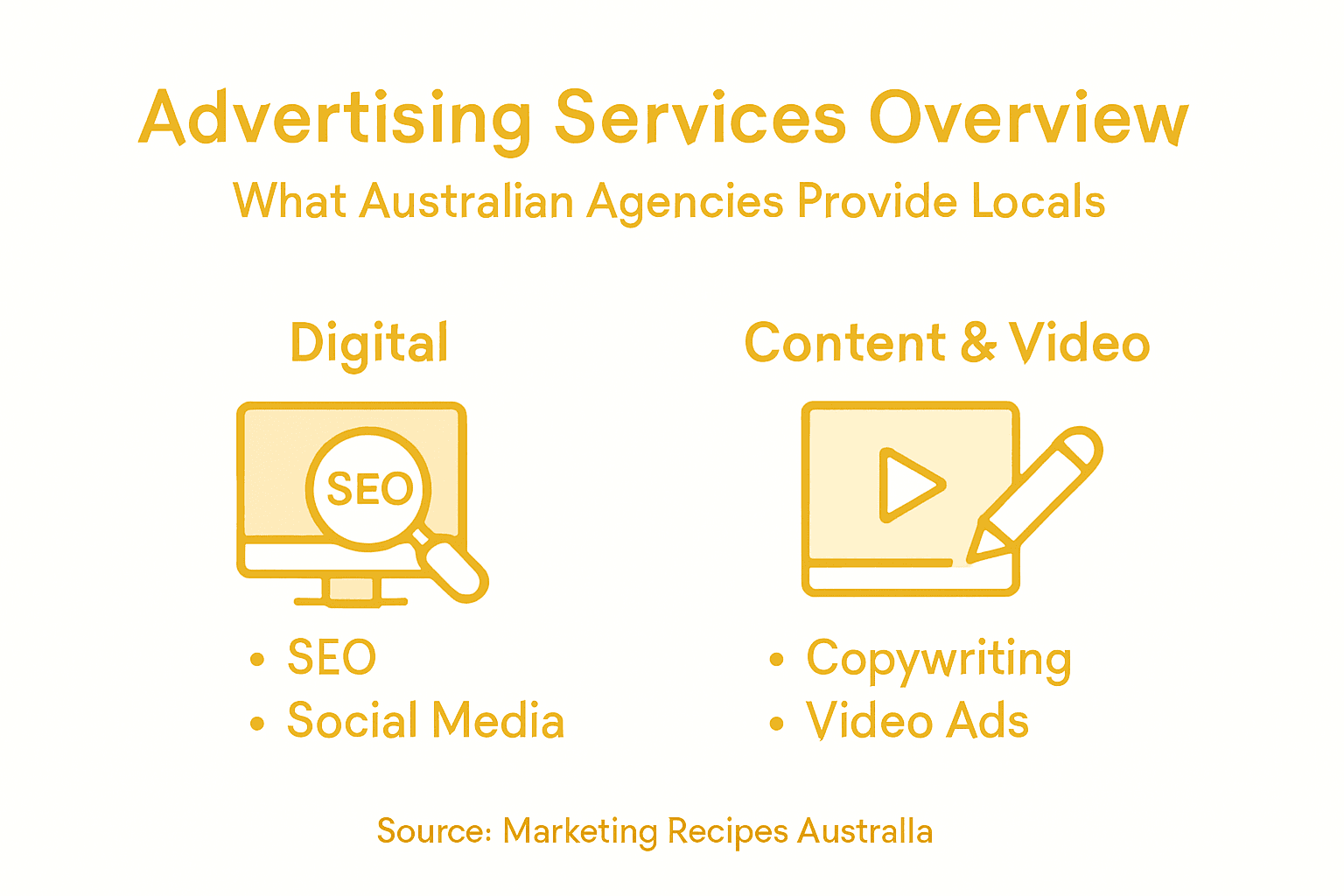
Content creation is everything that isn’t necessarily video or paid ads. It’s the blog post that explains how to choose the right product for your needs. It’s the email newsletter that keeps customers informed about sales and new arrivals. It’s the infographic that breaks down something complex into digestible pieces. It’s even the product descriptions on your website that help customers understand quality and value. Agencies craft these pieces strategically, addressing the questions your customers actually have and positioning your business as knowledgeable and trustworthy. What makes this approach work is that all three services feed each other. Your content gives you something to share on social media. Your videos become shareable content pieces. Your social media engagement tells you what topics matter to customers, which informs your next content pieces. The data from your digital campaigns shows which messages resonate, helping refine your video and content strategy. This full-funnel integration is what separates agencies that deliver results from those that simply keep you busy.
Pro tip: When discussing services with potential agencies, ask them specifically how they integrate their digital, video, and content work rather than treating each as a separate deliverable. Request to see examples where these three services worked together on a campaign, and ask what results that integration produced. This reveals whether they actually think strategically or simply execute tasks.
Legal Standards for Advertising in Australia
Advertising in Australia isn’t a free-for-all. There are actual rules that govern what you can say, how you say it, and where you can say it. As a retail business owner, understanding these standards protects you from costly mistakes and keeps your advertising campaigns compliant. The Australian regulatory framework emphasises ethical communication, factual accuracy, and audience appropriateness across all advertising. Regulatory frameworks for advertising emphasise transparency and accountability to ensure that public funds and private advertising serve the community responsibly. This means whether you’re promoting a sale, making claims about your products, or targeting specific customer groups, your agency needs to understand what’s legally permissible and what crosses the line. The consequences of getting this wrong range from having ads pulled down or removed from platforms to facing complaints to regulatory bodies, damaged reputation, and in serious cases, legal action.
The primary regulator for advertising standards in Australia is the Advertising Standards Bureau, which oversees compliance with the Australian Association of National Advertisers Code of Ethics. This code covers accuracy and truthfulness, which means you cannot make false or misleading claims about your products or services. If you say a product is “Australian made,” it genuinely needs to be made in Australia. If you claim to be the “cheapest in Gippsland,” you need evidence to support that. You cannot make health claims unless they’re substantiated, particularly important if you sell health or beauty products. Another critical area is targeting and discrimination. Your advertising cannot discriminate based on protected attributes like race, ethnicity, gender, age, or disability. You can target demographics (like “women aged 25-45”) for marketing efficiency, but you cannot create ads that demean or stereotype groups or exclude people based on protected characteristics. Advertising to children carries stricter rules. If your retail business targets young people, you need to be careful about making claims that appeal to children’s fantasies or desires in misleading ways, and you cannot encourage unsafe behaviour.
Price advertising and claims require particular attention for retail businesses. If you advertise a sale price, you must have genuine stock at that price available for a reasonable period. “While stocks last” is acceptable, but you cannot mislead customers about quantity or time limits. Comparative advertising, where you claim your products are better than competitors’ products, is allowed but must be fair and truthful. You cannot selectively present information to make false comparisons or knock off competitors unfairly. Social media advertising follows the same standards as traditional advertising, even though it feels more casual. A post promoting your business to friends must still comply with these codes. Your agency should understand these standards and build them into campaign development from the start. They should review your product claims before campaigns launch, ensure comparisons are fair and supported, and flag any areas of concern. Working with an agency that takes legal compliance seriously saves you from headaches down the track. Most legitimate Australian advertising agencies incorporate compliance checks into their workflows and can advise you when you’re approaching the boundaries of what’s acceptable.
This table outlines the main legal areas in Australian advertising, crucial for retail owners:
Legal Area | Common Risk Example | Agency Safeguard |
Misleading claims | False ‘Australian made’ ad | Requires evidence, fact checks |
Price advertising | Insufficient stock for sale | Inventory validation |
Comparative advertising | Unfair comparisons | Balanced, substantiated claims |
Advertising to children | Unsafe product depiction | Content review, age suitability |
Pro tip: Before launching any advertising campaign, ask your agency explicitly what compliance checks they perform and whether they have process documentation showing how they verify claims and ensure regulatory adherence. Request to see examples of how they’ve advised clients when a campaign idea crossed legal or ethical lines—this reveals whether they’re merely order-takers or genuine advisors.
Costs, Common Risks and Mistakes to Avoid
Advertising agency costs vary dramatically depending on what you actually need. A small retail business in Gippsland might spend anywhere from a few thousand dollars monthly for fractional digital marketing services to ten thousand dollars or more for a full-service agency managing all your marketing channels. You’ll typically encounter three cost categories. Creative development covers designing your ads, writing copy, producing videos, and developing strategy. Media buying is the cost of actually purchasing advertising space on Google, Facebook, Instagram, or other platforms. Campaign management and reporting covers the ongoing work of monitoring performance, adjusting campaigns, and providing you with results. Some agencies charge flat monthly retainers, others charge by the project, and some work on a performance basis where part of their fee depends on results. The trap many retail owners fall into is choosing an agency based solely on price. A cheaper agency might save you money in the short term but cost you far more if they’re not delivering results or, worse, creating advertising that breaks the law.
The real risks come from common mistakes that undermine your advertising investment or create legal liability. Misleading or deceptive claims represent a significant risk in Australian advertising, and this happens more often than you’d think. A retail owner might genuinely believe their products are “the best quality” or “locally made” without realising they need concrete evidence to support those claims. Your agency should push back on vague or unsupported claims before they go live. Another frequent mistake is unclear pricing. If you advertise a sale price of fifty dollars on an item normally priced at eighty dollars, customers need to understand exactly what that price includes. Hidden costs, conditions, or time limits that appear only in fine print create complaints and legal risk. Unsubstantiated health claims are particularly dangerous. If you sell skincare products and claim they reduce wrinkles or treat acne without clinical evidence, you’re inviting regulatory action. Misleading endorsements cause problems too. If you pay someone to endorse your products but don’t clearly disclose that relationship, you’re being deceptive. Inadequate legal compliance underpins many of these mistakes. Agencies that skip compliance reviews or push ahead with campaigns despite warnings set you up for trouble.
What separates businesses that thrive from those that struggle is understanding that your agency relationship requires transparent communication and rigorous processes. You should feel comfortable asking your agency to substantiate claims before they recommend them. They should show you how they check compliance. They should flag concerns rather than simply executing your requests without question. Red flags include agencies that promise unrealistic results (“we’ll triple your sales in three months”), those reluctant to discuss compliance, or those who don’t ask clarifying questions about your claims and offers. Cost mistakes happen when you pit agencies against each other on price alone. A slightly more expensive agency that builds in compliance checks and strategic thinking delivers better value than a cheap option that creates problems. Budget mistakes happen when you underfund campaigns or spread your budget across too many channels without focus. Your agency should help you allocate budget based on where your actual customers are and where your business can realistically compete. Geographic targeting mistakes occur when you advertise in the wrong regions or to the wrong demographics. A niche retail business might waste money advertising to everyone when targeted advertising to your actual customer profile would be far more efficient. The best protection is partnering with an agency that treats your business like their own, asks tough questions about what you’re claiming, and builds legal and strategic thinking into everything they do.
Pro tip: Request a detailed cost breakdown from any potential agency showing what you’re paying for across creative, media, and management, then ask them to explain how they prevent common advertising mistakes and what compliance processes they follow. A reluctance to discuss these areas clearly is a warning signal.
Unlock Tailored Marketing Solutions for Regional Australian Businesses
Navigating the unique challenges of marketing in regional Australia requires expertise that truly understands your local community, seasonal demands, and budget constraints. This article highlights the importance of agencies delivering regional-focused strategies, legal compliance, and integrated digital, video, and content services that work together to build authentic connections. If you want to avoid common pitfalls like misleading claims or ineffective ad spend, partnering with an agency that acts as an extension of your team can make all the difference.
At Marketing Recipes Australia, we bring over 30 years of experience helping retail and small businesses across Gippsland and beyond with a full menu of adaptable services. From strategic consulting and creative video production to digital campaigns and social media management, our kitchen-inspired approach cooks up bespoke marketing plans that are both affordable and results-driven. We understand regional retail needs and focus on measurable outcomes and compliance so your marketing budget works harder for you.

Ready to grow your local business with a trusted partner who knows regional markets inside out Visit Marketing Recipes Australia today and discover how our flexible and transparent marketing services can elevate your brand. Connect with us now to start crafting your strategic marketing recipe tailored to your community and customers.
Frequently Asked Questions
What services do advertising agencies in Australia offer for local businesses?
Advertising agencies in Australia provide a range of services including digital marketing, content creation, video production, social media management, and strategic consulting to help local businesses connect with their target audience.
How do I choose the right advertising agency for my retail business?
To choose the right agency, consider their experience with businesses similar to yours, ask for case studies demonstrating their results, and look for agencies that understand the unique needs of regional markets.
What is the importance of compliance in advertising for local businesses?
Compliance is crucial as it ensures that advertising is ethical and legally sound. This prevents misleading claims and protects businesses from legal repercussions and damages to their reputation.
How can digital marketing services enhance my retail advertising efforts?
Digital marketing services, such as SEO and social media management, enhance advertising efforts by increasing online visibility, engaging customers, and driving traffic to your website, ultimately leading to higher sales and customer loyalty.
Recommended
Comments